Showing posts with label Family. Show all posts

08 January, 2014

Outside

I went outside tonight,
and wasn’t supposed to.

I was supposed to be
locking the house
taking down decorations
cooking mealies,
But I leaned outside the door
and outside looked so full,

So I stepped into it.

It was turning dark out there,
My feet felt good in the pool.
I lay on concrete stones
Under the grey-blue 
and stretching behind the house
saw still white-streaked clouds.
The bats were out – 
swooping,
dipping for a drink. Behind
the roof two fir-trees have 
a bad haircut.
The trees around
must laugh;
We chopped off their heads
so they won’t fall on the house.

The yellow window lights
were in the pool,
The buzzing, tapping crickets
were just as loud as cars
and I smelt chlorine.

I lay outside, 5 minutes.

Then
I thought
I should go in;
The water would be boiling
the veggie shepherd’s pie, 
done,
the table needed setting.

There was a frog hopping by,
across the doorway, sneaking
to his place in the drainpipe.
“Mister Frog,” I warned,
You better not hop inside,
you better not croak all night.

I went outside tonight,
when I wasn’t supposed to
and it was beautiful.
I wanted to share it with you

But you aren’t here. 

04 July, 2013

Bucket-loads of treasure

I hope I'm as cool as my grandparents when I get to their age.

I'm staying with Granny and Grampa Dietsch, in New Jersey for a week and this morning, Grampa was writing an email to a man called Charles in Papua New Guinea.

"I wish he'd write in English," he said, "my Pidgin is a little rusty."

It's been a few decades since Grampa's had to use it.

I asked Grampa about how he and Granny got to Papua New Guinea.

"Well, let's see, this must have been 1950 or 51. I was about twenty three and I was heading to Manus (a small Island in Papau New Guinea) with Liebenzel. But before I left, I made sure to propose - Hilda was only nineteen so we had to wait another year until she could marry me. And Liebenzel wanted you to be in the mission field for two years before you got married but there was no place for her to stay on the island by herself. So I left and a year later, Hilda came over and we got married. She took a plane to Australia, then a ship out to the island. We had to delay the wedding by a two weeks, though, because there was this sailor that died in a car accident and I had to do the funeral.
I remember a team of Australian cricketers stood at the door of the church building, more like a hut, and watched. They wouldn't come inside because they were Catholic.
And then (he chuckles here) I got malaria that night and your Granny spent the first week of marriage nursing me!"

Granny called us in for breakfast and after we'd eaten our toast and boiled eggs, Granny and Grampa Dietsch read the Moravian Devotional and prayed together. It's a part of their morning routine - Grampa reads the German and Granny reads the English. Yesterday, they got into a discussion about the finicky German articles -di -da -das and so forth. Apparently Granny is better at knowing which one to use.

"You just grown up hearing what the right one is," she said.

Then it was the roots of German names. Dietsch comes from Deutsche (as in Deutschland) and Faustel (my great-grandmother's name) comes from the word "faust" meaning "fist".

"So, Faustel mean's 'little fist'", Grampa said, "oh but my grandmother had a big fist."
He chuckled.
"She loved the comic book, The Phantom, and read it to us kids there, but she couldn't read English so she just made the story up from the pictures. And, if the phone rang she'd pick it up and shout, 'Hello!? Nobody home!' and hang up."

At this point in the story, Grampa's giggling so hard he has to take his glasses off and wipe his eyes.

Grandparents hold a bucket-load of treasures. 

05 January, 2013

Lessons from an Oxford bridesmaid

Oxford is a fascinating place, especially over Christmas. Mulled wine and mince pies are everywhere; homes, churches, street corners, cafes and pubs. Glorious! Less glorious, and just as common, is the rain. Locals stroll through it like it's a warm, sunny day, while us foreigners dash hunched and bent from doorway to doorway, nipping into the first pound-store we see to buy umbrellas. We consistently managed to forget our umbrellas when we left the house in the morning; it wasn't raining then. Silly us.
Oxford's homeless people have pet dogs, Oxford's buildings manage to look both ancient and intellectual, and Oxford's giant buses patiently compete with pedestrians for space on the tiny roads. Oh, and people of all ages ride bicycles in all weather through streets, cobbled alleys and fields at all times of the day and night.
Splendid!
Anyone want to give me a job in Oxford?

As fascinating as these things were however, the strangest and most delightful thing I saw in Oxford was not the mulled wine or the giant buses or even the rain-impervious, bike-wielding locals. It was the silver ring on my brother's finger.

Twin brother, married. Weird.

Josh's wedding is one of the few British weddings that included ululating and lobola (bride price). The bride's family is probably grateful there were only about 15 of us Africans present, who knows what mischief we could have gotten up to if our numbers had been higher!

As a bridesmaid in the wedding I had important, behind-the-scenes access to what went on and I came away with a host of highly useful tips. I thought I'd share a few of the things I learnt:

1. Smiling all day gives you a headache at night. Pace yourself.
2. Doing your own "button-holes" (corsages) and bouquets cheaper and can be conveniently learnt from your local library flower-arranging book. Or from online printouts.
3. The secret to a professional-looking French manicure is cotton ear-buds and a little nail-polish remover.
4. You should always check if a bride's dress covers her shoes before scrubbing the bottom of them (so that the congregation can't see the scuff marks when she kneels).
5. White fluff (the kind that comes from a bridesmaid's cardigan) can be removed from a black suit (the kind that the groom wears) using rolled up cello-tape. Or a lint roller if you're lucky enough to bump into a well-organized and kind hotel guest.

More importantly though, I learnt that a marriage involves the joining of two old families and the creation of one new family; it's not just the joining of two people. This family-joining and family-creation takes hard work, a bit of pain and a lot of love.

02 September, 2012

Good guys and bad guys

For several months I have been a volunteer blogger for Amirah Boston, a safe house for girls who were once trafficked in the sex-trade industry. About six weeks ago I wrote an article for Amirah entitled "Good guys and bad guys". I've re-worked that post and would like to share it here. I know that's kind of cheating - re-using an old blogpost - but I liked the post, I worked hard on it, I think it's relevant outside of Amirah...and recycling is good, right?


Recently, I’ve been thinking a lot about war. Not a very cheery subject, I know, but one that has been pecking away at my mind, provoking some interesting questions. The most probing of which has gone something like this; is it possible for someone to believe so strongly that ‘I am right’ and ‘they are wrong’ that they’d go to war over it? That they’d kill, or tell others to kill for it?


Last week my dad and I took a 10-hour drive together and had the time and privacy to talk about all sorts of things. I asked him about his days on the national police force and what it was like to fight in the Rhodesian war. Back then (the 1970s) national service was required of all Rhodesian males and at 18-years-old, dad was leading squads of men, firing guns, transporting convoys of civilians through the bush, and watching for ambushes and landmines. I asked him what they were fighting for.

“Smith (Prime Minister at the time) was afraid of what the country would become,” he said. “The rebels in Mozambique were backed by China, the rebels in Zambia were backed by communist Russia.”

I struggled to reconcile this with the fact that my dad’s ‘side’ lost the war – the ‘rebels’ won. And today he sits in church, plays squash, has coffee and works alongside men who fought on both sides of that war – with and against him. ‘So,’ I thought, ‘what was the point of all that fighting? Who are the bad guys and the good guys and the victims?’

But war isn’t that simple.

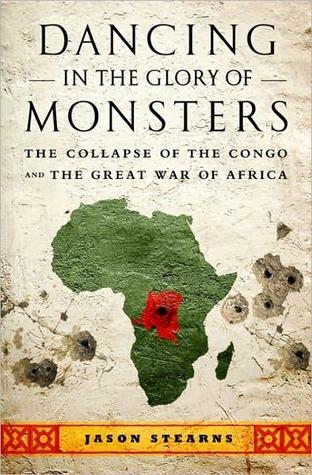
I’ve just started a book called Dancing in the Glory of Monsters about the war in central Africa. In it the author, Jason Stearns, interviews a Rwandan army commander and asks him about his role in the exiled government that opposed Paul Kagame.  The commander’s response to Stearns made me reevaluate my questions:

“You are being too logical about this!” said the commander, “We were in the middle of a war. We didn’t have time to think whether we were complicit in a genocide – we were just trying to survive.”

Now, I realize that this sounds like a pretty flimsy, even horrific excuse in light of the awful massacre that occurred and I’m not at all dismissing the actions of this or any other person who participated in the genocide. My point is that I can’t make a judgment either way; I wasn’t there. I didn’t feel the fear, didn’t live in the climate or context of those tribe’s histories, I wasn’t born in Rwanda. I didn’t live through that war. So why do I feel free to make judgments from a distance, comfortable and safe in my moral superiority over ‘those people’?

It's the same way I feel about human trafficking but it isn't that simple either. It's not about helpless victims and evil traffickers, it's about people. It's about human beings with histories, men and women that come from specific contexts, needs, fears and situations.  

In things like war and human trafficking we have a tendency to seek out the ‘evil person’ – the one who caused all this suffering – and we want to find him as soon as possible. Then we can heap hordes of blame and judgment on his or her head. It’s a tendency encouraged by today’s sound-bite media and our own short attention spans – we want the problem simplified, digestible, easy to solve, and easy to blame. It’s encouraged by movies like The Avengers where the good guys are always right and heroic, never make mistakes and always save the day, while the bad guys are so obviously and totally evil that no one doubts the necessity of their destruction. Of course they have to be taken out.

But in real life we can’t just separate everyone into heroes and villains, victims and killers. In real life, war, poverty and governments are made up of human beings that do both good and bad things.
The problem with my question is that it’s too simple; it takes only one reason for war – individual belief – and ignores other factors such as country history, economic context, social situation, political climate, family influence and so on. My dad helped me learn this lesson on that 10-hour car ride.

As I sat mulling over his words, over the picture of him as a young man holding a gun, over the question of what I’d do if I had to choose a side in a war, I voiced the thought that was bouncing around in my head.

“I can’t imagine anyone being so sure that they are right, that they’d send their whole country to war over it.”

He glanced at me, then back at the road. “The only way to declare war,” he said, “is with tears in your eyes and a heart that’s broken.” 

14 December, 2011

Home for Christmas

I recently wrote this Opinion piece for the Salem News, a brilliant local paper here on the Northshore, and since I've been feeling the guilt of a less-than-faithful blogger - especially compared to my sister (thanks Beks) - I thought I would reprieve myself a little by publishing something I've already written. 


I learnt who Bing Crosby was in 2005, during my first Christmas in America. Crosby’s Colgate-commercial smile and rich, deep voice floated out from my grandparents’ television as he sang, “I’ll be Home for Christmas.” My family had come from Zimbabwe to live in New Jersey for 10 months and I’d seen my first snow 30 days earlier on Thanksgiving morning. It was quite a change from the sunny, 70-degree December-weather I was used to. In Zimbabwe we don’t get snow and Christmas isn’t white, it’s wet. As children we always hoped for a rain-free day so we could go swimming with our cousins. Even now, grown up, living in Massachusetts and having experienced my share of New-England winters, it still feels surreal to be wrapped in sweaters and blankets, sipping tea and watching the white-coated world outside.

My feelings about Christmas are not the same as they were five years ago. For most of my life this holiday evolved around family, home and Jesus. December was a time of warm weather, stockings at the end of my bed, mince pies with cream, special church services and, of course, a huge family gathering of aunts, uncles, cousins and grandparents. But our last few Christmases have seen dwindling numbers back home; Grampa is no longer with us and the cousins have been dispersed through several countries and colleges.

Christmas has changed. I’ve changed.

I’m starting to see an ironic twist in the carol “I’ll be Home for Christmas.” The song was first released by Crosby in 1943 during World War II and it touched the hearts of soldiers and their families who were separated by the war. At that time everyone was hopeful that the end was in sight and all could go home. Today, with over 200,000 American military personnel currently deployed in foreign countries as of last June (according to the Department of Defense), many American families feel the same way.

However, it is not only soldiers that are separated from their families this December. About three percent of the world’s population – over 200 million people – currently lives outside their birth country, according to the United Nations Department of Economic and Social Affairs. Some of that three percent are international students (like me) studying far from home, staying on the campuses of colleges like Gordon, Salem State and Endicott. Others are fathers, brothers, daughters and mothers working in foreign countries worldwide to send money back to their families. We all won’t be home for Christmas.

I have discovered, however, that some of the things I miss most about Zimbabwe at Christmas can be found on the other side of the world too, right here at Gordon College. Family, home and Jesus are everywhere. I have been invited, welcomed and temporarily adopted by several faculty and staff members of the college. I have also discovered an eclectic family of internationals, students from Korea, the United Kingdom, Kenya and other places who, like me, are strangers in America and living at Gordon we have been able to find a home here, together. Most importantly, I have found people who have a similar heart for Jesus, who understand why December is so special to me.

So even without the hot weather I’m accustomed to and though I cannot go swimming with my cousins, Christmases away from Zimbabwe are not necessarily Christmases away from home because I seem to have found families all over the place.

25 July, 2010

Goodbye 7 Pine

I have been house-sitting for a couple of my professors for the past 2 weeks. Being so far from home and living in the campus dorms has made me miss some of the simple things of a "normal" life; taking care of pets, having my own kitchen & pantry, sitting outside drinking ice-tea and reading the paper (or just doing the cross-word in my case...). But house-sitting gives me a chance to do some of the "domestic" things I've missed. It was two weeks of wonderful relaxation!


Sadly the two weeks is done.
This poem is a little tribute to my time there :)


This place has been my own;
A space
In time and life to be alone;
To escape and hide myself
From reality.

I shared it with no one;
It was solely mine,
For a time.

I shall miss you, 7 Pine.