Showing posts with label Zimbabwe. Show all posts

27 April, 2014

More Than My Whiteness

Race is never not a part of my interactions and identity in Zim. And I’m constantly gob-smacked when I encounter a person living his/her life in oblivion to the colour of their own skin and the weight of history that it carries, the invisible implications etched all over, and the reality of their own prejudices.

The other day, I crossed from one side of Harare to the other; from one racial and social existence to another, from one world and life to another.

It was a little strange to realize that I don’t belong in either world.

On Wednesday, I spent a few hours “down-down-town”, shopping with a friend in the part of town where streets are crammed and crowded with people. We bumped and wended our way through the striding, shouting, grabbing masses, being called after to buy coat-hangers, phone-lines, onions, men’s belts, passport-holders… you name it. It’s the part of town where you can buy flats/pumps for $4, where you don’t hear a word of English being chatted, where shouts of “hey sissi” (sister) and “I love you, baby” follow you around if you happen to be female. Oh yeah, and white. There is nary a white person around, downtown. Except that day, there was me; a shining beacon of whiteness that didn’t belong among the brown bodies flowing and shouting their way through the streets. My friend and I drew stares and comments and whistles. Oh the joys of being female. My friend – a stunning black girl with high-cheek bones, smooth, dark skin and a fashion sense I envy – was the perfect companion and guide. We laughed at some comments, shook our heads at others, ignored most. A few times, however, when I refused to engage with some idiot male, someone would shout after us in Shona and she would interpret: “You with the dark skin, tell the other pretty one to come here” or, from a man leaning out the window of a kombi, “why is it that one is born light and the other born dark?” Appraised and valued like goats or hats, all based on the colour of our skins.

And then from there I drove across town to Borrowdale Village – a shopping centre with prosperous businesses, high-end shops, fancy restaurants and the city’s newest cinemas. It’s the part of Harare where pumps/flats cost $20-50, where white ladies meet for tea and black business men for lunch, where money is no object, and brand-name-clothed teens stroll through the shops with iPhones in hand. In the coffee shop where I parked myself for the afternoon to write e-mails, the waiters are all black and the only person working the cash register was (and is always) a white guy. (OK, maybe that was callous, but it’s reality). It’s actually one of my favourite coffee places – the service is excellent, the food and drink good and the wifi decent. I can sit myself there for a few, uninterrupted hours with my computer.

But. It’s also a place where I feel the scratchy, sticky feeling of being a rich, white young woman – there is always a keen and heavy social/racial divide between myself and the waiter who serves me. I feel just as uncomfortable and out-of-place there as I do downtown. The waiter speaks to my whiteness, my assumed wealth, my supposed higher social standing. Server and Served live in separate realities and only interact as goods and money exchange hands, relating as through an unbreakable window of one-way glass. There’s no relationship, no conversation as equals, no way for me to cross over or reach out. Once again, I, we, are appraised and dismissed by the colour of our skin.

My race is important, it’s a huge part of me, but it’s not all there is to me. Or you. Or the person standing next to you in the grocery queue. I think, realizing that I don’t belong on either “side” of town is kind of cool. It lets me step into each one, every now and then, to discover how to go deeper, how to share the beauty of our differences instead of letting them define and divide us. 

14 December, 2013

A child's eye-view

The other day my sister showed me a 3-minute TED talk on 30-day challenges, i.e. undertaking something new, exciting, tough (and so on) for thirty days. Something you've always wanted to do but ‘never had the time’, or been too afraid, or whatever other excuse you can come up with. Well, this week marks the start of the first of (hopefully) many 30-day challenges for me.

Challenge 1: take a picture a day and blog about it. By the end, I hope to have 30 precious, unique memories that of the next month of my life. 30 days, 30 pictures, 30 memories
Here’s picture number one:

A child’s eye view

For the past two days I've been re-cataloging a children’s library, moving books from shelf to shelf (I have the aching arms and feet to prove it), getting my hands black with about 20-years’ worth of dust and making a complete mess of the library! I never in my life imagined I’d be a librarian but, starting in January, I’ll be the new librarian at a local primary school here in Zim. I vacillate between “yay, this is so exciting!!” and “yikes! I haven’t the foggiest idea what I’m doing!!” I have ideas and plans, this vision of what I would love the library to be and look like. But I’m not really a visionary type of person and I feel like I’m bumbling through a forest of chaotic pages, scary Dewey decimal codes, cardboard spines, so many words and way too much dust. And the dust knows more than I do. 

But I’m a complete nerd and I love books. I want to make books as magical and life-saving for the kids of this primary school as they have been (and are) for me.

At the library this week, one of my hardest, most painful challenge was moving six metal shelves a little lower down on the rack so that children can (try to) read the titles of the books on the top shelf (hence the photo). The shelves were heavy, my arms were tired, and I was making an awful racket dropping those silly shelves. Each time I dropped one I’d climb down off my chair, pick up the dang thing and say something to the effect of:

“Why the heck am I doing this? I’m hot, I’m tired, I want a cup of tea and this shelf is just not fitting back into the holes I got it out of in the first place. Is putting it one handwidth lower really going to make any difference??”


Well, maybe one hand width won’t be noticeable, and maybe the kids still won’t really be able to read the titles of the books on top shelf. But all the little, dirty, painful, time-consuming (and I must admit, exciting) things I’ve been doing are important. I'm building something big out of many small parts and getting to know the little parts of that something as I build (I wonder if God felt/feels like this when He makes a new baby). I now know that the library’s greatest contributor is Enid Blighton, that there are more bird books than other animals, that the picture books section is where I want to start reading when I get a free moment (followed closely by the children’s poetry section), and that even ballet gets its own dictionary. (I’m sure, as a children’s librarian, reading all these books is part of my job description.)

So I'll keep moving those shelves, shuffling those books around, making signs and trying to look at things from a child's point of view. I'm sure I'm making loads of mistakes, but hey, that's how you learn, right?

02 November, 2013

A 50c Packet of Chips

Going to the shops here in Zim is like entering a battlefield.

You drive into the parking lot and join the other cars, circling like vultures, ready to swoop on any available space. There! You swerve and squeeze in quickly, avoiding eye-contact with the lady ahead of you who was scoping out that space too.

Ok, now, maybe if you keep your head down, don't look up, they won't see you, they'll leave you alone.
You peek up through the windshield. Dang it. Spotted.
Who are you kidding; they all made a missile-like beeline for your car the moment you pulled into your lucky space. They're hovering outside your window - no ways they'd pass up this opportunity to accost a white face and her supposedly bulging wallet. (Why do they assume you have money to waste on an umbrella fly-net, some windshield wipers and a pack of AA batteries??)
You take your time, hoping they'll go away - you undo your seat-belt, put the window up very slowly, pull up the handbrake, hide your bag of books under the seat, stick your handbag over your shoulder, check your face in the rear-view mirror...
Dang. They aren't going anywhere.
Ah well, here goes.
You open the door, armed with a smile and ready to make a dash through any available gaps. The security guard is the first to demand attention with a "yes, hello madame!"
You hate being called madame; you're not married and most of the time you're young enough to be the speaker's daughter or granddaughter. Or at least their peer.
You already have a line for the guard; "I'll just be five minutes, don't worry about watching my car." Translation: Don't bother with me, I'm not giving you a tip.
He skulks away. One down...
"Maid's uniforms, madame," a lady waves them in your face.
"Peaches and naartjiis, madame" a man thrusts a box of colourful fruit under your nose.
"No, thank you!" you shake your head to them both. The woman walks away with a humpph, making you feel bad for not buying something from her that you don't need, with money you don't have to spare. The man is more persistent and he trails you as you disengage yourself from the sea of cars.
"Good price, madame, cheap, cheap!"
"No, thank you."
You turn away, keep walking, keep smiling. Resist the urge to flee.
Another man approaches and pushes a laminated paper at you, grinning ever-so-sweetly. You groan inwardly.  On comes more guilt.
"Sorry, not today," you say to him. He gives you a thumbs-up and a disappointed nod.
You don't even look at the paper; you know what it says. Or the gist of what it says: that he's deaf, doesn't have a job, has been officially certified not to work, needs some help to get a small business going ...etc etc. That man, or his prototype, has been around for years. You remember him from when you were in high school and came shopping here with your mum.

You're almost at the shop entrance! Almost free...
"One dollar please, madame."
Ah...the biggest arrow of guilt. A little boy looks up at you with big, sad eyes (you wonder if they practice that sad look in the mirror) and his hands out.
"No, my boy," you say.
"Hungry, madame."
You tell yourself its ok not to give him something - who knows what he'll spend the money on, he could be buying glue to sniff. Or maybe someone takes the money from him and he doesn't get any of it himself. It happens - older street-kid bullies, or family members. Still, you feel heavy with guilt as you finally duck into the store, sheltered for a moment from the onslaught of people in need.

You buy your 70c gum and a 50c packet of chips.
The little boy is hanging on the trolleys outside as you come out.
"Want some chips?" you say and hand him the packet. He grins like gold and claps his hands in thanks. Instead of the relief, you feel more guilt. All it took was a stupid, little packet of chips make him so happy.

You stride quickly to your car, keys at the ready (the security guard is nowhere in sight), hoping for a quick getaway. A man with packets of unshelled-peanuts and some oranges jumps into your path.
"Peanuts, M - "
"No, thank you!" you cut him off, crisp and cool.
Enough! Enough of the guilt!
You think about the little boy and his 50c packet of chips. You dive into the car and take a deep breath.
Gosh, what a dumb world.

27 August, 2013

Alien at home; a quest for citizenship

There’s nothing like stomping all over town, being sent back and forth between the Immigration office, the national ID office and the Passport office (each a 20 minute walk from the other… great planning there, Zim government) with no results, to make you feel hopeless.

 So much for Civil Service.

 As my dad says, “It’s neither civil, nor serving”: efficiency is non-existent and nobody seems to want to do their job. They make you feel guilty for bothering their busy day with work. Work, of all things!

According to the new Zimbabwean constitution, we can finally apply for dual citizenship as Zimbabwe-born residents. My brother and I decided to give it a try. I think we were in denial of what we were really up against.

We got up at 4.30am to join the queue of people waiting for their birth certificates and national IDs outside Market Square (crnr Bank St. and Mbuya Nehanda). As soon as we joined the back of the line we were swarmed by several young guys (in varying stages of soberness) asking if we wanted ‘help’. “I have you a nice spot at the front, my sister,” said one man.
“No thanks, I’ll wait in line,” I said.
"Good price, my sister."
They left, seeing there was no money to be made out of the two murungus. One young guy though, he looked about 15 years old, was persistent.
 “Nice spot for you, my friend, no waiting.”
He got pulled away by two older drunk guys and they started arguing. The whole line of queuers turned to watch. The drunk guys whacked him in the face and left. The teen came back, ranting at the rest of us in Shona about not feeling any pain, about what idiots those men had been. I'm not sure what I would have done if they'd started actually beating him up. It's a sobering thought at 5 in the morning.

As the sun came up, the men disappeared and a policeman came walking down the line, shouting in Shona that no line-shifting was allowed. Where was he 3 hours ago?

Just before 8am the gates opened and they split us into two lines – one for birth certificates, one for national IDs. I was surprised at their organization. They filed us all in and as Josh and I neared the front and showed them our paperwork, the young man told us we were in the wrong place (this after 3 hours of queuing in the cold) and had to go to “Makombe House, room 100” for a letter of permission to get the status on our IDs changed from “alien” to “citizen”.

Makombe. The dreaded passport office. You can queue for days without any results.

On our way to Makombe we decided to try Linquenda House, the immigration office, where Josh had been told he could apply for citizenship. After talking to someone 'upstairs' and running around to make copies of our papers to leave with him, he told us he was too busy to get to it today, and to come back on Friday. We traipsed off to Makombe.
It was as chaotic as I’d expected; crowds of people everywhere, outside and in, lines forming down each body-crammed corridor, people jam-packed and trying to squeeze around each other, tattered paper signs on the walls. An accurate reflection of the true state of this country.

We eventually found room 100 and joined the little crowd waiting to get inside. The harassed-looking, unsmiling young lady at the desk looked at us through bleary eyes as we explained our situation.
“Go to Mrs Chivore,” she said, “room 89. She can answer your questions.”
We squeezed and pushed our way to room 89.

Mrs. Chivore turned out to be an impressive, imposing woman who had the air of a headmistress waiting to see errant children. She worked in the Inquiries Office and was in high demand. We waited in line again.

When we showed her our paperwork and explained our situation, she looked confused.
“No. You must go to Market Square,” she said.
“But we were just there and they sent us to you!”
“Well, they do this sort of thing every day.”
“Can we get a letter from you saying that we have permission to do this?”
“No no, you don’t need a letter. Just ask for the supervisor.”

Josh and I pushed our way through to the outside of the building and tramped back to Market Square. I tracked down the startled young man from the gate.
“We were here at 5am this morning and you sent us to Makombe. They said they don’t need to give us a letter, you do this sort of thing every day. Can we get it done, please.”

He scrambled away to call his supervisor.

Josh and I were made to sit outside a large office for 10 minutes while the young man held our IDs, birth certificates and passports captive. When he finally called us in we realized that we were talking to the big cheese of Market Square. He had a spacious office, private and quite, nothing like the mayhem of our lives outside. There was a Zim flag hanging behind his desk and a picture of Comrade President Robert Mugabe on the wall.

My heart tried to beat its way up my throat and out my mouth.

 “You are not permanent residents of this country so you cannot get your citizen ID,” said the big cheese.

Frantic thoughts bounced around my head. What?! Of course we’re residents! …oh no; they’re going to tell us we aren’t residents and take away our right to live here! 

"Where do you live?” he asked.
“In Meighbelreign.”

I imagined him calling the police, and them shouting at us and telling us we had one day to leave the country because we didn’t belong here. I imagined having to say goodbye yet again to my family, to my dreams of finally living at home.
Josh was more level-headed and explained what we’d gone through to get to him.
Big Cheese kept talking and flipping through our passports, pointing to our re-entry visas from the past 5 years.
“You see," he said, "in 2005, you had permanent residency,” he pointed to a tiny scribble under one of our re-entry visa stamps (the stamps that say “ZIMBABWE RESIDENTS RE-ENTRY PERMIT”….ahem) where someone had used their blue, Eversharp pen to scrawl ‘permanent residence.’ in barely-legible writing.
“You need Immigration to endorse you as permanent residents, then you can come back to me and we’ll give you your ID.”

Ah. I breathed. No deporting.

“You see,” he went on, “the new Constitution has not been passed on to the administration yet. It is awaiting a ruling by parliament before it goes into effect.”

So, he was just stalling.

We thanked him, took our passports, Alien IDs, birth certificates and left.
I was tempted to pull my blue, Eversharp pen from my bag and scribble ‘permanent residence’ in my passport and go back to him. But that might be pushing our luck.

Truth is, the whole country is stalling. Legally, constitutionally, they are required to give us our Zimbabwe passports, to recognize us as citizens by birth. But the ‘law’ is easy to get around, easy to re-write. And they are doing everything they can to throw obstacles in our path.

The civil service may be woefully inefficient but they are well united in their efforts to keep us from dual citizenship. If we press to hard, will they simply throw us in jail?

Welcome home, alien.

31 July, 2013

Election Day

It's election day today - the first Presidential (and Parliamentary) elections since Zimbabwe's coalition government was formed in 2009, the first elections since the violence and devastation of 2008.

I arrived back home a week ago to a country that seems normal, that seems peaceful and happy. But there's a strange undercurrent of below-the-surface-fear.

Mom and I were driving through town the other day and had stopped in the middle of a typical intersection, one with the usual crowded cacophony of cars and people; combis wedged into every possible space in between cars, Buddie (phone card) sellers, newspaper sellers and guys selling car phone chargers, elections stickers, flags and belts all standing in the middle of the road, in the midst of the cars. Women walking with bundles on their heads or wearing heels and a business suit, out on lunch break.
We heard the sound of sirens approaching from somewhere in front of us and a motorcycle zipped past on our right, followed by four more, all with their sirens screaming. The President was coming. The light ahead turned green but nobody moved; all cars and people were still and waiting, faces carefully neutral.
After the motorbikes came the police-cars and in the middle of the entourage was the black car with flags, protected by an army truck behind and an army truck in front, both filled with soldiers, their guns trained out at the rest of us. Then came more motorbikes and lastly, an ambulance.
The street breathed again.
People moved, kept walking, avoided eye contact and didn't joke or smile. Cars drove onwards and the strange silence was covered up with growing talk.

That's the feeling on the streets; people are quiet and worried. Though campaigning has been "mostly peaceful, with few reports of intimidation" (according to the BBC), the fear is of a different kind. 

I was chatting with a friend who said that a couple weeks ago, in a suburb just outside the city, government men came in and rounded up the people. Every person had their picture taken. Then the men left. No one was told what the pictures were for, when they would be used or who had ordered them.

"At least when they're beating you , you know exactly what it's about. But this...you don't know what they could do," my friend said.

People are afraid because we don't know what to fear. We don't know what will happen

At the moment, there's nothing we can do but wait. We're going on about our lives as usual - I have a kitchen tea to prepare for and (eventually) a job to find. But at the back of our minds are questions: Do we hope for a "New Zimbabwe"? Do we fear for our safety? Will anything change at all?

As a friend said this morning, heading to the polling station in town to vote, "we'll know in five days". We hope. 

13 March, 2013

An elephant's funeral

What do you wear to an American funeral, at a high Anglican church, in cold New England? I thought black was a safe bet: black dress, black tights black boots. And a grey-blue scarf. I briefly wondered if the scarf was too much. Then I rolled my eyes - oh please! This was for Dr. Lumsdaine.  His trademarks were untucked shirts and skewed ties, chalk-handprints on his trousers, messy hair and mis-matched socks. I don't think he'd care about my scarf.

I'm going to miss him.

Dr. Lumsdaine (Dr. D), was my old politics professor and he passed away after a sudden heart attack last week. He was 64 and his unexpected death left our college community shaken. Dr. D was an intellectual giant, a genius, I think and an extremely humble man who devoted his life to his students. He'd give out his phone number and say, "call me anytime of day or night", and he constantly prayed with students. He'd start his sentences with a nasal "eerrr....yyeeeaaaah" and his sentences with, "now the answer to this question may very well be no, or it may be yes, or it may be, 'You're crazy, Dr. D, to even think this' - which are all  ok...but..."

He was also disorganized and came late to class. He'd pull of quirky maneuvers in the classroom, (pretending to get livid and walking out just to make a point, or, when he slipped a disc in his back, he would teach from a kneeling position, or lying across the window sill) and conducted his office hours in the cafeteria (better access to students, he said). He was a little socially inappropriate. It was hard to have a conversation with him and sometimes he made loud, offensive comments in the wrong places.
Students loved him for it.

Dr. D was a man of simple touch (a hand on your shoulder) and moments of (often awkward) silence. I imagine him in heaven now, sitting with Jesus, staring with his big, watery eyes at the Lord's face. This time, there's a hand on Dr. D's shoulder and they're both smiling and silent. No awkwardness. No words necessary.

His death and funeral (we spent two hours bouncing up and down - sitting, standing, kneeling - through the hymns, prayers, communion, dedications, blessings, a homily, and a benediction. We all spoke in hushed tones when making the rounds at the after-service reception, not very Dr. D-like at all) reminded me of a funeral I saw six months ago in Zim.

We were camping in Hwange National Park and on one particular game drive we saw 100 elephants (so several herds) standing still and quiet at a watering hole. Strange. There was no splashing, no angry grunts, no playing young, no dust-throwing. Just the occasional flap of ears, or shifting of feet.They stood gathered in gray, silent groups around or in the water. Every now and then a herd would leave silently and slowly, soon replaced by a new, silent herd that lumbered forward from the dusty distance or the line of trees.
Very strange.

Then we noticed a small lump behind an anthill a short distance from the water. A small elephant body on the ground. That was why the elephants were silent - they were respecting the loss of someone's baby.
But the elephants didn't look or move in its direction, didn't acknowledge it as they walked by (not unlike my silent walk passed Dr. D's coffin on my way to the front of the church for communion). I wondered what secret communication was taking place - how was news of the death being sent through the bush? What low mourning was being rumbled at a frequency indistinguishable to my human ears?

After some time, a female moved towards the body. She approached slowly, stopping near it and swaying. She began stroking it with her trunk, nudging its ears with her feet. Four and then seven more elephants joined her, caressing, nudging, lifting it's ears and forming a wall around the body. Then in ones and twos, this farewell committee turned around and and continued on their way, slowly and steadily trudging off.

The herds around the water began to stir. Someone splashed. A few started blowing and grunting. More herds arrived, others left. Noise and movement returned.
The funeral was over.

02 September, 2012

Good guys and bad guys

For several months I have been a volunteer blogger for Amirah Boston, a safe house for girls who were once trafficked in the sex-trade industry. About six weeks ago I wrote an article for Amirah entitled "Good guys and bad guys". I've re-worked that post and would like to share it here. I know that's kind of cheating - re-using an old blogpost - but I liked the post, I worked hard on it, I think it's relevant outside of Amirah...and recycling is good, right?


Recently, I’ve been thinking a lot about war. Not a very cheery subject, I know, but one that has been pecking away at my mind, provoking some interesting questions. The most probing of which has gone something like this; is it possible for someone to believe so strongly that ‘I am right’ and ‘they are wrong’ that they’d go to war over it? That they’d kill, or tell others to kill for it?


Last week my dad and I took a 10-hour drive together and had the time and privacy to talk about all sorts of things. I asked him about his days on the national police force and what it was like to fight in the Rhodesian war. Back then (the 1970s) national service was required of all Rhodesian males and at 18-years-old, dad was leading squads of men, firing guns, transporting convoys of civilians through the bush, and watching for ambushes and landmines. I asked him what they were fighting for.

“Smith (Prime Minister at the time) was afraid of what the country would become,” he said. “The rebels in Mozambique were backed by China, the rebels in Zambia were backed by communist Russia.”

I struggled to reconcile this with the fact that my dad’s ‘side’ lost the war – the ‘rebels’ won. And today he sits in church, plays squash, has coffee and works alongside men who fought on both sides of that war – with and against him. ‘So,’ I thought, ‘what was the point of all that fighting? Who are the bad guys and the good guys and the victims?’

But war isn’t that simple.

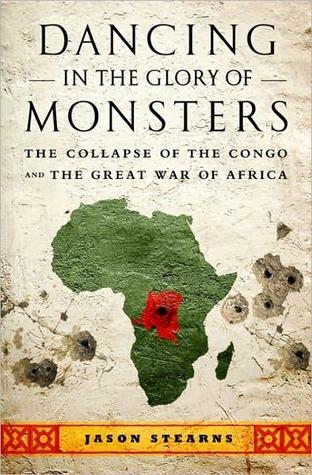
I’ve just started a book called Dancing in the Glory of Monsters about the war in central Africa. In it the author, Jason Stearns, interviews a Rwandan army commander and asks him about his role in the exiled government that opposed Paul Kagame.  The commander’s response to Stearns made me reevaluate my questions:

“You are being too logical about this!” said the commander, “We were in the middle of a war. We didn’t have time to think whether we were complicit in a genocide – we were just trying to survive.”

Now, I realize that this sounds like a pretty flimsy, even horrific excuse in light of the awful massacre that occurred and I’m not at all dismissing the actions of this or any other person who participated in the genocide. My point is that I can’t make a judgment either way; I wasn’t there. I didn’t feel the fear, didn’t live in the climate or context of those tribe’s histories, I wasn’t born in Rwanda. I didn’t live through that war. So why do I feel free to make judgments from a distance, comfortable and safe in my moral superiority over ‘those people’?

It's the same way I feel about human trafficking but it isn't that simple either. It's not about helpless victims and evil traffickers, it's about people. It's about human beings with histories, men and women that come from specific contexts, needs, fears and situations.  

In things like war and human trafficking we have a tendency to seek out the ‘evil person’ – the one who caused all this suffering – and we want to find him as soon as possible. Then we can heap hordes of blame and judgment on his or her head. It’s a tendency encouraged by today’s sound-bite media and our own short attention spans – we want the problem simplified, digestible, easy to solve, and easy to blame. It’s encouraged by movies like The Avengers where the good guys are always right and heroic, never make mistakes and always save the day, while the bad guys are so obviously and totally evil that no one doubts the necessity of their destruction. Of course they have to be taken out.

But in real life we can’t just separate everyone into heroes and villains, victims and killers. In real life, war, poverty and governments are made up of human beings that do both good and bad things.
The problem with my question is that it’s too simple; it takes only one reason for war – individual belief – and ignores other factors such as country history, economic context, social situation, political climate, family influence and so on. My dad helped me learn this lesson on that 10-hour car ride.

As I sat mulling over his words, over the picture of him as a young man holding a gun, over the question of what I’d do if I had to choose a side in a war, I voiced the thought that was bouncing around in my head.

“I can’t imagine anyone being so sure that they are right, that they’d send their whole country to war over it.”

He glanced at me, then back at the road. “The only way to declare war,” he said, “is with tears in your eyes and a heart that’s broken.” 

02 August, 2010

Aware of my Alienness

I have been living in America for two years now and people often ask me, "So, how has it been adjusting to America?"
My routine answer is usually something like, "Well, I don't think I'll ever fully adjust."
Most will then nod and smile sympathetically, knowingly.
But they don't know. They don't know what it is to be a stranger, in a strange land.


There are moments when I feel an uneasiness tingling through my body, like a cool chill that raises goosebumps on my flesh. In these moments I seem to awaken from as if from sleep, look out at the strangeness around me and wonder, 'Where am I? What on earth am I doing here, in this unreal world?'
It is at these times that I feel my alienness most acutely, and my foreignness seems to rise to the surface, seeping past the mask of normalcy in which I have shrouded myself.
This feeling is triggered by the most mundane, simple and every-day things of American life - men in baseball uniforms, the overflowing isles of Wal-Mart, the smell of a cold, air-conditioned room, the sight of snow - things that, to an African girl from Zimbabwe are wild, extraordinary and other-worldly. They make me feel that I am living in a dream or experiencing the unreality of a Hollywood movie.


Travelling on the train into Boston this weekend I felt such a feeling creeping into my consciousness. The city of Boston, with its graffiti words spray-painted on the back walls of apartment buildings, its black fire-escapes, reminiscent of movie stars like Tom Cruise or Matt Damon, its slim, well-dressed, high-heeled females carrying Styrofoam mugs of Dunkin Donuts Coffee - this city often sparks off an awareness of my own alienness. It churns up buried emotions - a disquieting mixture of excitement and fear. Excitement at the plethora of possibilities and opportunities this rich, wide world has to offer, with its accessibility to wealth, possessions and travel. In such a place I sometimes feel that I could truly do, have or be anything! The future is open to me and its unknown potentials are exhilarating!


But there is fear too - fear of losing myself, of forgetting where I have come from, or worse, of being forgotten. This world is changing me; I am no longer the girl I was when I left Africa two years ago. Even now, when I speak to my family on the phone and hear their voices filled with duty in taking my calls, when the e-mails become less and less as they become busier... when I am not missed - then I know that I am being subconsciously forgotten. 
My ultimate fear is that the alienness that I feel here in America will return with me when I go back, manifesting itself in new, terrifying ways in that place I call home. To be an alien in my own land, my own family - that is my fear.

25 July, 2010

Goodbye 7 Pine

I have been house-sitting for a couple of my professors for the past 2 weeks. Being so far from home and living in the campus dorms has made me miss some of the simple things of a "normal" life; taking care of pets, having my own kitchen & pantry, sitting outside drinking ice-tea and reading the paper (or just doing the cross-word in my case...). But house-sitting gives me a chance to do some of the "domestic" things I've missed. It was two weeks of wonderful relaxation!


Sadly the two weeks is done.
This poem is a little tribute to my time there :)


This place has been my own;
A space
In time and life to be alone;
To escape and hide myself
From reality.

I shared it with no one;
It was solely mine,
For a time.

I shall miss you, 7 Pine.