02 September, 2012

Good guys and bad guys

For several months I have been a volunteer blogger for Amirah Boston, a safe house for girls who were once trafficked in the sex-trade industry. About six weeks ago I wrote an article for Amirah entitled "Good guys and bad guys". I've re-worked that post and would like to share it here. I know that's kind of cheating - re-using an old blogpost - but I liked the post, I worked hard on it, I think it's relevant outside of Amirah...and recycling is good, right?

Recently, I’ve been thinking a lot about war. Not a very cheery subject, I know, but one that has been pecking away at my mind, provoking some interesting questions. The most probing of which has gone something like this; is it possible for someone to believe so strongly that ‘I am right’ and ‘they are wrong’ that they’d go to war over it? That they’d kill, or tell others to kill for it?


Last week my dad and I took a 10-hour drive together and had the time and privacy to talk about all sorts of things. I asked him about his days on the national police force and what it was like to fight in the Rhodesian war. Back then (the 1970s) national service was required of all Rhodesian males and at 18-years-old, dad was leading squads of men, firing guns, transporting convoys of civilians through the bush, and watching for ambushes and landmines. I asked him what they were fighting for.

“Smith (Prime Minister at the time) was afraid of what the country would become,” he said. “The rebels in Mozambique were backed by China, the rebels in Zambia were backed by communist Russia.”

I struggled to reconcile this with the fact that my dad’s ‘side’ lost the war – the ‘rebels’ won. And today he sits in church, plays squash, has coffee and works alongside men who fought on both sides of that war – with and against him. ‘So,’ I thought, ‘what was the point of all that fighting? Who are the bad guys and the good guys and the victims?’

But war isn’t that simple.

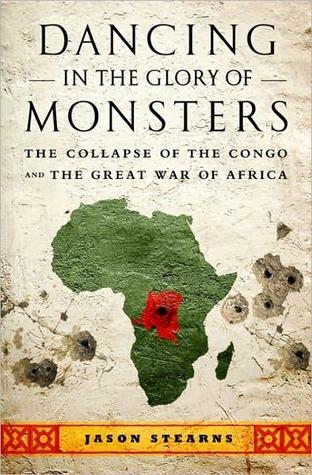
I’ve just started a book called Dancing in the Glory of Monsters about the war in central Africa. In it the author, Jason Stearns, interviews a Rwandan army commander and asks him about his role in the exiled government that opposed Paul Kagame.  The commander’s response to Stearns made me reevaluate my questions:

“You are being too logical about this!” said the commander, “We were in the middle of a war. We didn’t have time to think whether we were complicit in a genocide – we were just trying to survive.”

Now, I realize that this sounds like a pretty flimsy, even horrific excuse in light of the awful massacre that occurred and I’m not at all dismissing the actions of this or any other person who participated in the genocide. My point is that I can’t make a judgment either way; I wasn’t there. I didn’t feel the fear, didn’t live in the climate or context of those tribe’s histories, I wasn’t born in Rwanda. I didn’t live through that war. So why do I feel free to make judgments from a distance, comfortable and safe in my moral superiority over ‘those people’?

It's the same way I feel about human trafficking but it isn't that simple either. It's not about helpless victims and evil traffickers, it's about people. It's about human beings with histories, men and women that come from specific contexts, needs, fears and situations.  

In things like war and human trafficking we have a tendency to seek out the ‘evil person’ – the one who caused all this suffering – and we want to find him as soon as possible. Then we can heap hordes of blame and judgment on his or her head. It’s a tendency encouraged by today’s sound-bite media and our own short attention spans – we want the problem simplified, digestible, easy to solve, and easy to blame. It’s encouraged by movies like The Avengers where the good guys are always right and heroic, never make mistakes and always save the day, while the bad guys are so obviously and totally evil that no one doubts the necessity of their destruction. Of course they have to be taken out.

But in real life we can’t just separate everyone into heroes and villains, victims and killers. In real life, war, poverty and governments are made up of human beings that do both good and bad things.
The problem with my question is that it’s too simple; it takes only one reason for war – individual belief – and ignores other factors such as country history, economic context, social situation, political climate, family influence and so on. My dad helped me learn this lesson on that 10-hour car ride.

As I sat mulling over his words, over the picture of him as a young man holding a gun, over the question of what I’d do if I had to choose a side in a war, I voiced the thought that was bouncing around in my head.

“I can’t imagine anyone being so sure that they are right, that they’d send their whole country to war over it.”

He glanced at me, then back at the road. “The only way to declare war,” he said, “is with tears in your eyes and a heart that’s broken.” 

25 August, 2012

Just me and the spiders

This week I've been learning the joys, and the loneliness, of solitude.

I recently moved into a new apartment and I have the whole place - a kitchen, lounge, flatscreen TV (not much on besides summer re-runs of The Mentalist) , spacious bedroom (my favourite feature being the light in the closet...genius!), cute little bathroom and a small porch complete with couches and candles - all to myself! I can keep the space neat and clean and clutter-free, I can cook and bake at any time of night or day, I can read, sleep, sit and think without interruption or housework or school work.

The peace and quiet is lovely!

But it's also surprisingly lonely.

In college I lived with 3 other girls...on a campus containing about 1500 chattering, sleep-evading, caffeine-loaded students. There were always people around, always someone to see, always someone to see you, seldom a moment alone. It was fun. And frustrating.

In Zim home is also crowded and loud, but in a different way. There's usually 6 to 9 other people in the house and that amount of people takes quite a bit of maintenance. The cooking, cleaning, driving, organizing, tea-making, eating, planning and talking seldom stops. There's always something needing to be done. Solitude requires a deliberate and determined effort at separation, something I didn't find very easy.

Now that I'm living by myself, I appreciate the chance for solitude. But the alone-ness will take getting used to.

One of the features of my new apartment is the abundance of spiders. They live on the ceiling, in the closets, above the doors and under the lamps. I'm not a huge fan of bugs but I don't really like killing them, spiders especially. It seems rather arrogant and thoughtless to kill bugs for the sake of it, simply because we humans are bigger and think they're yucky. After all, they got here first and they're useful in getting rid of the ugly bugs and stinging mosquitoes. And they're company. But they aren't the nicest roommates - they build their webs in new places each night so I get a faceful of fluffy web each time I walk onto the porch, they leave empty bug carcasses on the floor and sometimes (I admit) I find them a little creepy. But more than that, their presence makes me feel like my house isn't lived in (by humans, I mean. Or at least a human). So. There's my conundrum. The presence of the spiders goes against my clean, neat, house-motherly feelings but they're not really hurting me, they're useful creatures and they're company.

It's sort of the same way I feel about my solitude; I both appreciate it and I'm afraid of it.

I've taken to turning on BBC Radio in the mornings before work because I'm unnerved by the lack of people-presence. When I wake up now there's no hum of voices coming from behind the kitchen door at 6.30 in the morning, no warm pot of tea sitting on the counter or bowls of porridge steaming on the table. There's no yellow glow of light under bedroom doors in the hallway at night, no loud conversations and laughter over big suppers, no crowding around the kitchen table for tea and discussions, no one to eat my baking, not even the sticky slobber of dogs to greet me when I walk outside in the garden. I have the solitude that I've craved so often over the past 5 years but I'm not sure how I feel about it. I'm sometimes thrilled and embrace it wholeheartedly, but I'm sometimes uneasy and want to flee to find people, noise, and conversation.

So...what do I do with the solitude, and what do I do with the spiders?

For now, I think I'll let them stay. But every now and then I might just chase them both away to embrace a little more noise, a little humanness, and a little companionship.

23 August, 2012

Seeded fridgecake

I just made the best fridgecake I've ever tasted! And I just sort of threw it together with whatever I had in my kitchen. Here's how...

4 oz (1/2cup) butter
3T cocoa powder
2T honey
3T maple syrup
250g vanilla wafers
1/3C raisins
2T sunflower seeds
2T sesame seeds

Melt the butter on the stove, add the cocoa, honey, and syrup.
Crush the wafers. Add the raisins and seeds.
Combine the butter mixture with the wafer mixture until well-coated. Press into a small brownie pan and refrigerate for 2 hours. Annnndddd....voila! the seeds just make it yummo!


18 March, 2012

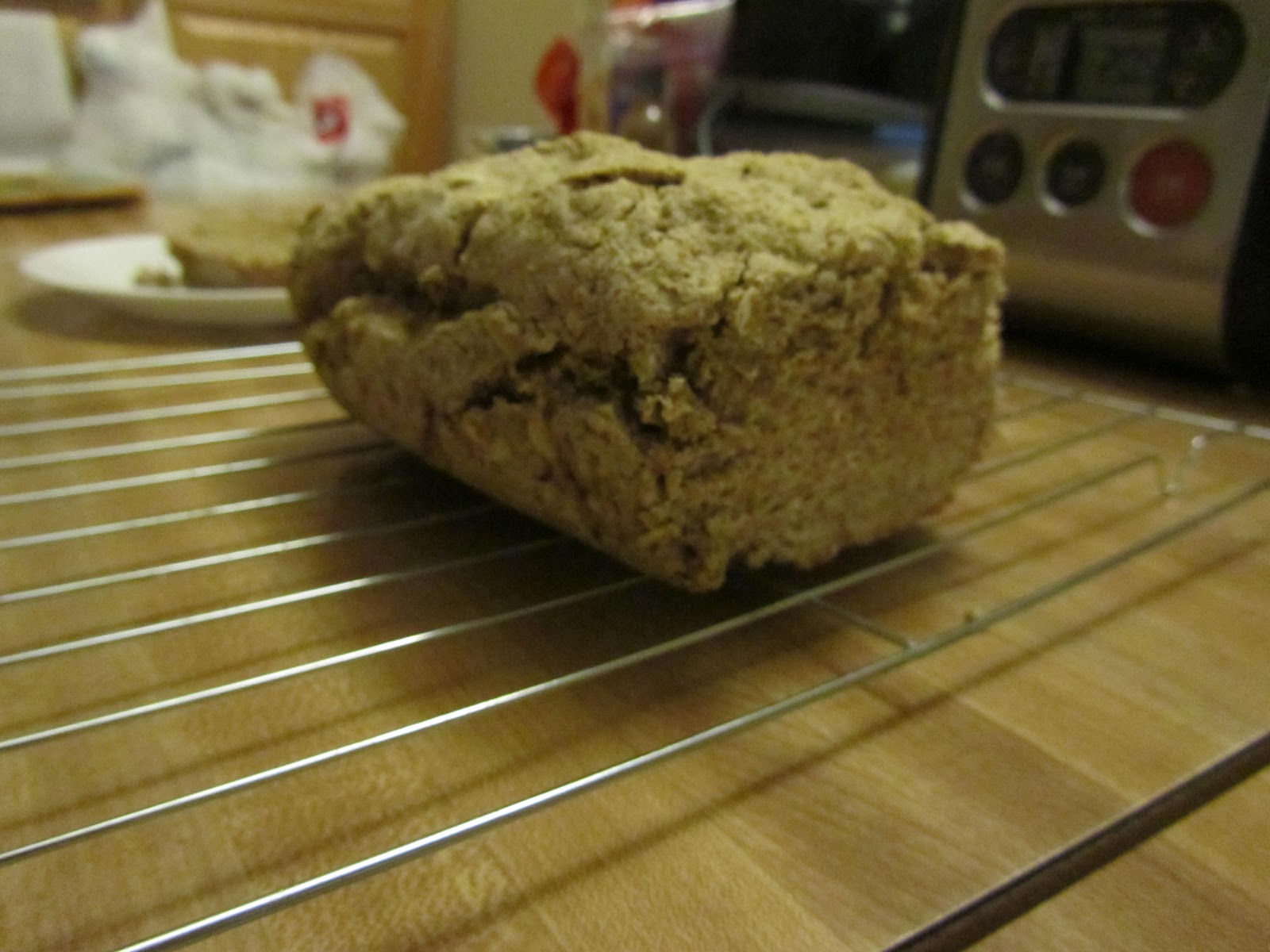
Wheaten Bread for St. Patrick's Day

I know it's a day late but in honour of St. Patrick's Day (and just because I wanted to) I decided to make Irish wheaten bread.

I've wanted to go to Ireland since I was a little girl. I think the initial reason had something to do with a movie I saw about fairies (or faeries...I'm not sure what the difference is) and leprechauns. Ireland seemed to be a magical place with the sea and the fisherman that lived by the sea, with women that had thick red hair and with mysterious, dark men that spoke in lilting accents.... Whatever the initial reason, Ireland has been the place that comes to mind when people ask, "if you could go to one place in the world, where would it be?"
Well, this December I finally got to visit Ireland with my siblings. We stayed in Dublin and then in Lisbon, just outside of Belfast. It was beautiful, over and above my expectations, and this brief description could never do it justice! I got to experience the windiest day of my life when we traveled to the coast and saw Giant's Causeway, I felt the amazing warmth and hospitality of the Irish, discovered their teasing humour and tasted their amazing food! But my appetite for the country has not been satisfied, only whetted and teased; I am determined to go back! I want to see the country in the Summer, to learn more about its history, about the division between north and south, to spend time with the people who showed me such love.

One thing I enjoyed in Northern Ireland is wheaten bread - a hearty, grainy bread. Here's Mrs Bittle's (our hostess in Lisbon) recipe...enjoy a little taste of Ireland!

Wheaten Bread


2 C wholewheat flour (actually its wheaten meal flour but I assume wholewheat is the American equivalent)
3/4 C plain flour
1/3 C rolled oats (heaped)
1/4 C sugar
1 tsp baking soda
1 tsp salt
1/4 cup butter/margarine softened
1 C buttermilk

Mix all the dry ingredients. Bind with the marg and buttermilk. (dough will be dry-ish...I found mixing it with me hands easier) Place into greased and floured loaf pan and cook on 150 C/ 300 F for about an hour. Let cool in the pan for 10 minutes then remove and cover with a cloth.
Tastes great hot with butter - eat for breakfast or afternoon tea!

14 December, 2011

Home for Christmas

I recently wrote this Opinion piece for the Salem News, a brilliant local paper here on the Northshore, and since I've been feeling the guilt of a less-than-faithful blogger - especially compared to my sister (thanks Beks) - I thought I would reprieve myself a little by publishing something I've already written. 


I learnt who Bing Crosby was in 2005, during my first Christmas in America. Crosby’s Colgate-commercial smile and rich, deep voice floated out from my grandparents’ television as he sang, “I’ll be Home for Christmas.” My family had come from Zimbabwe to live in New Jersey for 10 months and I’d seen my first snow 30 days earlier on Thanksgiving morning. It was quite a change from the sunny, 70-degree December-weather I was used to. In Zimbabwe we don’t get snow and Christmas isn’t white, it’s wet. As children we always hoped for a rain-free day so we could go swimming with our cousins. Even now, grown up, living in Massachusetts and having experienced my share of New-England winters, it still feels surreal to be wrapped in sweaters and blankets, sipping tea and watching the white-coated world outside.

My feelings about Christmas are not the same as they were five years ago. For most of my life this holiday evolved around family, home and Jesus. December was a time of warm weather, stockings at the end of my bed, mince pies with cream, special church services and, of course, a huge family gathering of aunts, uncles, cousins and grandparents. But our last few Christmases have seen dwindling numbers back home; Grampa is no longer with us and the cousins have been dispersed through several countries and colleges.

Christmas has changed. I’ve changed.

I’m starting to see an ironic twist in the carol “I’ll be Home for Christmas.” The song was first released by Crosby in 1943 during World War II and it touched the hearts of soldiers and their families who were separated by the war. At that time everyone was hopeful that the end was in sight and all could go home. Today, with over 200,000 American military personnel currently deployed in foreign countries as of last June (according to the Department of Defense), many American families feel the same way.

However, it is not only soldiers that are separated from their families this December. About three percent of the world’s population – over 200 million people – currently lives outside their birth country, according to the United Nations Department of Economic and Social Affairs. Some of that three percent are international students (like me) studying far from home, staying on the campuses of colleges like Gordon, Salem State and Endicott. Others are fathers, brothers, daughters and mothers working in foreign countries worldwide to send money back to their families. We all won’t be home for Christmas.

I have discovered, however, that some of the things I miss most about Zimbabwe at Christmas can be found on the other side of the world too, right here at Gordon College. Family, home and Jesus are everywhere. I have been invited, welcomed and temporarily adopted by several faculty and staff members of the college. I have also discovered an eclectic family of internationals, students from Korea, the United Kingdom, Kenya and other places who, like me, are strangers in America and living at Gordon we have been able to find a home here, together. Most importantly, I have found people who have a similar heart for Jesus, who understand why December is so special to me.

So even without the hot weather I’m accustomed to and though I cannot go swimming with my cousins, Christmases away from Zimbabwe are not necessarily Christmases away from home because I seem to have found families all over the place.

05 November, 2011

Lemon poppy seed muffins


Ever since I watched Jamie Oliver make an amazing pie - and then tried it myself the next day and had the crust come out light, crumbly and delicious (quite a feat for me, pies are not my best friends...unless I'm eating them), since then, I have been calling myself a fan of Jamie Oliver. I find him kind of endearing, especially since he reminds me of my cousin.
That being said, here is an adaption from one of his recipes - Almond cake with lemon poppy seeds
I decided to change them into muffins - and they turned out really well! It's a very sweet, slightly crunchy muffin - moist and perfect with a cup of tea.


Heat Oven to 350 degrees F. Grease 12 muffin cups or a 20cm round cake tin.

Beat together until light and fluffy:
120g (1/2 Cup) soft butter
1/2 Cup sugar

Add 4 egg yolks one at a time
Add the zest and juice of 2 lemons and beat until smooth.

Pulse in 1 & 1/4 Cups self-raising flour and 1/2Cup finely chopped walnuts (The original recipe called for almond flour which I don't have but this seemed to work just fine)
Add 2T milk and stir until just combined. Stir in 2-3T poppy seeds and set aside.

In another bowl whisk the egg whites from your four eggs til they form soft peaks (ahem - a little bragging; I did this by hand...I'd suggest walking a round the room while doing it, and making grunting noises every now and then to take your mind off the pain in your arm).
Beat in 1 T sugar until smooth.


Stir a few spoonfuls of the egg into the flour mixture and mix together. Fold the rest of the egg carefully into it.
Spoon into muffin or cake tin and pop it into the oven for 25-30 minutes (muffins) and 45 minutes (cake), until it has risen and is a golden brown.

04 November, 2011

Apparently there's a "correct" way to eat pizza

"You eat your pizza backwards."
I've been told this fairly often. Apparently there is a correct way to eat pizza and I've been doing it wrong all my life. Ever since I was small, and our family would get our favourite kinds of pizza as a special treat, I've been eating it backwards. We'd get pizza from Pizza Inn, the Zimbabwean version of Pizza Hut...kind of... (see the picture below). They once had ostrich-meat pizza. But we got Margarita (cheese and tomato), Hawaiian (pineapple and ham) and Four Seasons for mom who likes olives. I never really understood what Four Seasons was... I've always eaten my pizza by taking one bite off the end, crunching through the crust, and then chomping slowly through the remainder, savouring the gooey, cheese-soaked middle for my final bites.

I remember when I was getting ready to come to America for the first time and an American missionary in our church warned my mom that we would have to learn the correct way to open a milk carton or we would be laughed at. Apparently there is a correct way to open milk cartons.
I didn't know all these rules; why tomato sauce (ketchup) is so popular or why everyone craves Mac n' Cheese and I'm still amazed by the slices of flavourless (sorry), pre-cut, neat orange and yellow squares of cheese that come packaged and separated individually by films of plastic.

I knew how to eat sadza though, rolling the steaming white paste into a ball with my fingertips, dipping it in the meat stew or vege relish and popping it into my mouth, keeping one hand clean. I knew to wash the rich, dark mud off the carrot before I crunched my way through it and throw the green, leafy hair on the compost pile or giving it to the chickens. I knew my mouth, hands and feet would be stained pink, red and purple for days if I went to the mulberry tree.
But none of this helped in America; you can't pick fruit off the trees unless you pay an entrance fee and there is no mealie-meal for the sadza. Pizza's one of the few things you can eat with your hands and there's no "double-dipping" allowed. It's a new world with its own rules.


I don't have a picture of Pizza Inn, but here's the ice-cream version; "Creamy Inn". Zim has Pizza Inn, Creamy Inn, Chicken Inn and Bakers Inn.